Transforming Old Bats into Modern-Defensive Weapons
A coach's guide to upgrading an aged GKI Kung Fu DX with Yinhe Qing long pips for control, spin reversal, and junior-friendly defensive play.

Marcus Chen
Equipment Specialist · 10 min read
Learn the details
Master your equipment with comprehensive guides on maintenance, repair, and selection. Elevate your game through optimal gear care.

A coach's guide to upgrading an aged GKI Kung Fu DX with Yinhe Qing long pips for control, spin reversal, and junior-friendly defensive play.

Marcus Chen
Equipment Specialist · 10 min read
RepairDon't throw away that expensive blade just yet. Learn how to repair minor edge damage and seal splinters to restore performance.
Read Article arrow_forwardBlade repair guide
A practical repair sequence for bringing a damaged table tennis blade back into service while protecting its flat playing surfaces, handle, and rubbers.
Watch the repair video play_arrowRemove loose grip tape and brush away dust before assessing the damage. Check the handle joint, the blade edges, and both playing surfaces. If the plies are separating across a large area, the blade is badly warped, or the handle is loose at the neck, professional repair or replacement is safer than forcing the parts together.
For shallow dents, loose fibers, or small edge voids, work a small amount of Fevicol SH into the damaged area. A visiting card or other thin, clean plastic edge can push adhesive into the gap without gouging the surrounding wood. Remove excess glue before it hardens, then let the repair cure fully.
Once dry, sand lightly with fine abrasive paper until the edge is smooth and the blade can sit flat. Round only the damaged corner; do not aggressively sand the top or bottom playing surfaces, because changing their flatness can affect rubber adhesion and rebound.
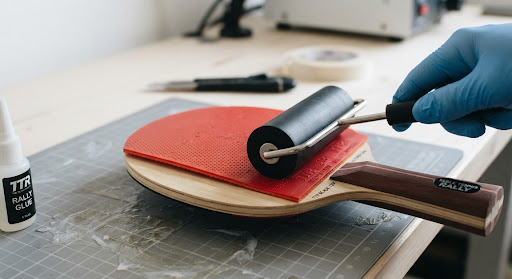
Clean the blade surface and the rubber backs before assembly. Apply a thin, even coat of water-based table tennis glue to the blade and rubber, allow both films to become transparent and tacky, then align the rubber from the handle outward. Roll it down gradually to avoid bubbles and trim only after the bond is secure.
Press the assembled rubbers overnight under a flat, evenly distributed weight with clean paper or a protective sheet between the rubber and the weight. The pressure should keep the surfaces seated, not crush the blade or imprint the rubber.
Important: Adhesive labels and curing times vary. Use ventilation, protect your hands and eyes, and treat structural handle or ply damage as a repair that needs careful inspection rather than a cosmetic glue job.
Rubber installation tutorial
A clean, repeatable method for attaching table tennis rubbers without bubbles, wrinkles, or loose edges.
Remove old adhesive from the blade with patience and light sanding. The wood should be smooth, dry, and free of dust. Clean the rubber backing with a dry cloth and check that it is flat before applying glue.
Thick glue does not create a stronger setup. It adds weight, can change the feel, and makes the rubber harder to remove cleanly later.
Start at the handle end and align the rubber carefully before allowing the rest of the sheet to touch the blade. Roll outward with a rubber roller or a clean bottle to push air toward the edges. Trim around the blade only after the bond is secure, then press the finished setup flat overnight under even, moderate weight.
Finish: Inspect the perimeter the next morning. If an edge lifts, do not pull the rubber farther; lift only the loose section, add a small amount of glue, and press it flat again.
Rubber selection guide
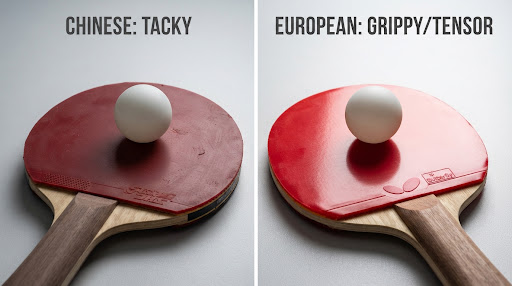
Tackiness and grip both help create spin, but they produce different timing, rebound, and maintenance demands.
A tacky topsheet can hold the ball briefly during slow serves, pushes, and brush loops. It rewards an upward, committed stroke and gives excellent control in the short game, but a hard tacky rubber may feel slow unless the player supplies enough acceleration.
A grippy, elastic topsheet engages quickly and usually provides more easy speed for flicks, blocks, and counterloops. It is often more forgiving when contact is slightly late, though its higher catapult can make short receives and touch shots more sensitive.
Quick equipment tip
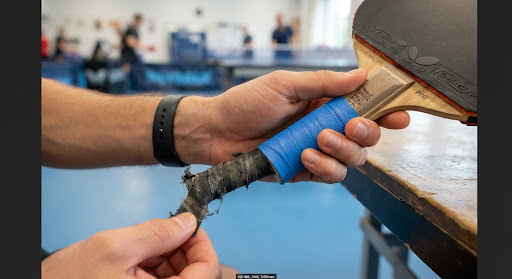
A fresh handle wrap improves comfort, consistency, and control before small grip problems become technique problems.
Swap the grip when it becomes slick, shiny, compressed, frayed, or permanently damp with sweat. If your hand shifts during serves or you find yourself tightening your grip to keep control, the tape is no longer doing its job.
Practical rule: Replace grip tape whenever it affects your grip pressure or confidence, not only when it visibly falls apart.
Coach's equipment guide
Academy coaches can unlock a new tactical dimension for junior players by upcycling aged pre-made bats, specifically the GKI Kung Fu DX, into control-centric, long-pips demonstration tools using Yinhe Qing rubber.

Both Yinhe Neptune and Yinhe Qing are long-pips rubbers, but they support different defensive philosophies. Neptune is suited to classic deep chopping: its slightly grippier, more flexible pips reward wrist action and brushing contact. Qing is designed for close-to-table defense, with pimple geometry and a thin sheet that emphasize passive spin reversal and a wobbly, disruptive trajectory on simple blocks and pushes.
For children who already rely on pushes and chops, Qing rewards minimal wrist work with maximum disruption. It is a practical way to build confidence close to the table before introducing more advanced looping technique.
The Kung Fu DX is a 5-ply all-wood blade built around control and a balanced feel. Compared with a faster 3-ply attacking blade such as the GKI Offensive XX, it absorbs incoming pace, provides longer dwell time, and dampens passive shots. Paired with long pips, that slower response puts the focus on control and spin manipulation rather than raw speed.
Yinhe Qing is available in OX, 0.5 mm, and 0.7 mm variants. OX maximizes reversal and produces a dead, low-bounce feel, making it ideal for teaching pure push-block and chop-block mechanics. It also demands precise timing. A 0.5 mm or 0.7 mm sponge adds a small cushion that helps younger players guide the ball deeper while preserving awkward trajectories and strong reversal.
Work slowly around the edges. The goal is to protect the blade surface, not to win a race against old adhesive.
Use water-based table tennis glue, or a double-sided glue sheet for OX. Apply one thin, even layer to the wood and one thin, even layer to the rubber backing. Wait 10 to 15 minutes, until both layers turn transparent, then press the surfaces together. Multiple layers can deaden the feel and make a thin long-pips sheet lumpy.
Avoid warping: do not use cello tape on the pimple side. Use paper masking tape lightly across the pips, or place paper over the blade and slide it out while rolling the rubber down from a 1 cm exposed strip at the handle. Remove masking tape slowly after assembly.
Many juniors using entry-level attacking bats find that passive pushes pop up and become easy targets. The Kung Fu DX plus Yinhe Qing setup changes that feedback loop:
That immediate "aha" moment gives children a tangible tactical identity. They can learn to disrupt rhythm and make opponents uncomfortable without being forced into an unnatural looping style.
Budget equipment guide
Yinhe Apollo, Jupiter 3, Big Dipper, DHS Hurricane, Xiom Vega Pro Hybrid, and other rubbers can all sound tacky, fast, or spin-oriented. They do not play alike. This guide compares them with a Fan Zhendong ALC-style reference setup and focuses on the closest useful playing characteristics at a lower cost.

The benchmark is a Butterfly Fan Zhendong ALC-style blade, boosted DHS Hurricane 3 Provincial Blue Sponge 39° on the forehand, and Butterfly Dignics 09C on the backhand. The budget blade under consideration is the Friendship/729 Blue ALC or Blue ALC Advance. An inexpensive rubber does not need to be identical to a premium one; it needs to deliver the right balance of grip, speed, throw, and control for the player's stroke.
Dignics 09C combines a mildly tacky topsheet with a dynamic sponge, offering strong grip, a high arc, and acceleration when the ball is actively engaged. Yinhe Apollo is closer to a traditional Chinese rubber: very tacky, dense, and comparatively unresponsive without a powerful stroke or boosting.
| Characteristic | Dignics 09C | Yinhe Apollo |
|---|---|---|
| Topsheet | Mildly tacky | Very tacky |
| Sponge | Dynamic and springy | Dense and linear |
| Throw / passive speed | Medium-high / moderate-high | Low-medium / low |
| Best use | Modern hybrid play | Traditional Chinese looping |
Apollo is useful for a hard, controlled forehand, but tackiness alone does not make it equivalent to Dignics 09C.
Jupiter 3 Asia has a tackier surface and harder Chinese-style feel. It suits a long, physical brush-looping stroke and offers strong service and receive control, high topsheet grip, low passive bounce, and more liveliness than a traditional unboosted Chinese rubber. It may feel easier than Apollo for a player accustomed to boosted Hurricane 3, though it will not match boosted Provincial blue sponge at full power.
The Euro version uses a more elastic sponge and a less extreme tacky feel, making it more suitable for backhand flicks, active blocks, opening loops against backspin, and close-table counterlooping. It is not a Dignics 09C clone, but it is one of the most practical budget hybrid options.
Yinhe Big Dipper sits between traditional Chinese tacky rubbers and European tensor rubbers. Its moderately tacky topsheet and elastic sponge give it more built-in speed than Apollo or standard Hurricane 3. A harder 39° or 40° version suits a firm forehand; a softer 38° version is easier to activate on the backhand. It offers useful value, although its trajectory is slightly flatter than Dignics 09C.
The forehand benchmark is boosted DHS Hurricane 3 Provincial Blue Sponge: powerful, spin-heavy, and demanding. A rubber that is merely fast will not match it; the topsheet must also grip the ball during a forceful upward stroke.
| Rubber | Tackiness | Catapult | Forehand fit |
|---|---|---|---|
| Boosted H3 Provincial Blue | Very high | Very high | Reference standard |
| DHS Hurricane 9 Blue | Very high | High | Ready-to-use alternative |
| DHS NEO Hurricane 3 | Very high | Medium | Closest route when boosted |
| Jupiter 3 Asia | High | Medium-high | Practical budget choice |
| Hurricane 8 / 729 Battle 2 | High | Medium | Firm traditional forehand |
| Big Dipper / Apollo | Medium-high / very high | High / low | Hybrid / controlled power |
Dignics 09C combines grip with a responsive sponge for compact flicks, active blocks, and counterloops. Xiom Vega Pro Hybrid is the most technically complete alternative when the budget permits. DHS Hurricane 8-80 in 37° or 38° offers tack with a springier sponge, while Yinhe Jupiter 3 Euro in 37° or 38° is the best low-cost controlled hybrid.
Donic Bluefire M3, DHS GoldArc 9, Tibhar MX-P, Tibhar Infinity, and Palio AK47 are more pure-speed or conventional attacking options. They provide easy catapult but not the sticky contact associated with Hurricane or Dignics 09C.
The regular Friendship/729 Blue ALC is the safer Fan Zhendong ALC-style starting point. It should provide a crisp outer-carbon impact, more dwell than an extremely rigid blade, better tolerance during opening loops, and a manageable balance with tacky rubbers. The Blue ALC Advance is faster and stiffer, giving a more direct response, greater finishing power, and a flatter trajectory.
A stiff blade does not automatically create more spin: contact quality, rubber grip, acceleration, and timing still decide the result. If a player previously found a fast premade bat difficult to control, the regular Blue ALC is the conservative first step.
A Donic Senso Ultra Carbon with Bluefire M3 on one side and unboosted Hurricane 3 Neo on the other can feel unbalanced. M3 is lively and high-throw; H3 Neo is slower, harder, and more linear. A flexible or vibrating blade can exaggerate the difference. The older GKI Kung Fu DX may feel calmer because it is slower and more predictable, not because it is faster or more advanced.
Blue ALC, Jupiter 3 Asia 39° or 40° forehand, Jupiter 3 Euro 37° or 38° backhand.
Blue ALC, NEO Hurricane 3 black 39° forehand, Hurricane 8-80 red 37° or 38° backhand.
Blue ALC, Hurricane 9 Blue forehand, Hurricane 8-80 or Vega Pro Hybrid backhand.
For the safest transition from the Donic setup to a Fan Zhendong ALC-style system, choose the regular Blue ALC before the Advance. Pair it with boosted NEO Hurricane 3 for the closest Chinese forehand route, or Jupiter 3 Asia for a livelier budget option. On the backhand, Hurricane 8-80 offers tack and spring, while Jupiter 3 Euro is the most affordable hybrid option.
Choose the blade for the desired feel, then select rubbers that complement it. Equipment can support timing, acceleration, and technique, but it cannot replace them.